
Nano Cosmetic Fillings and Ceramic Inlays & Onlays: When Can They Spare You a Crown?
November 10, 2026
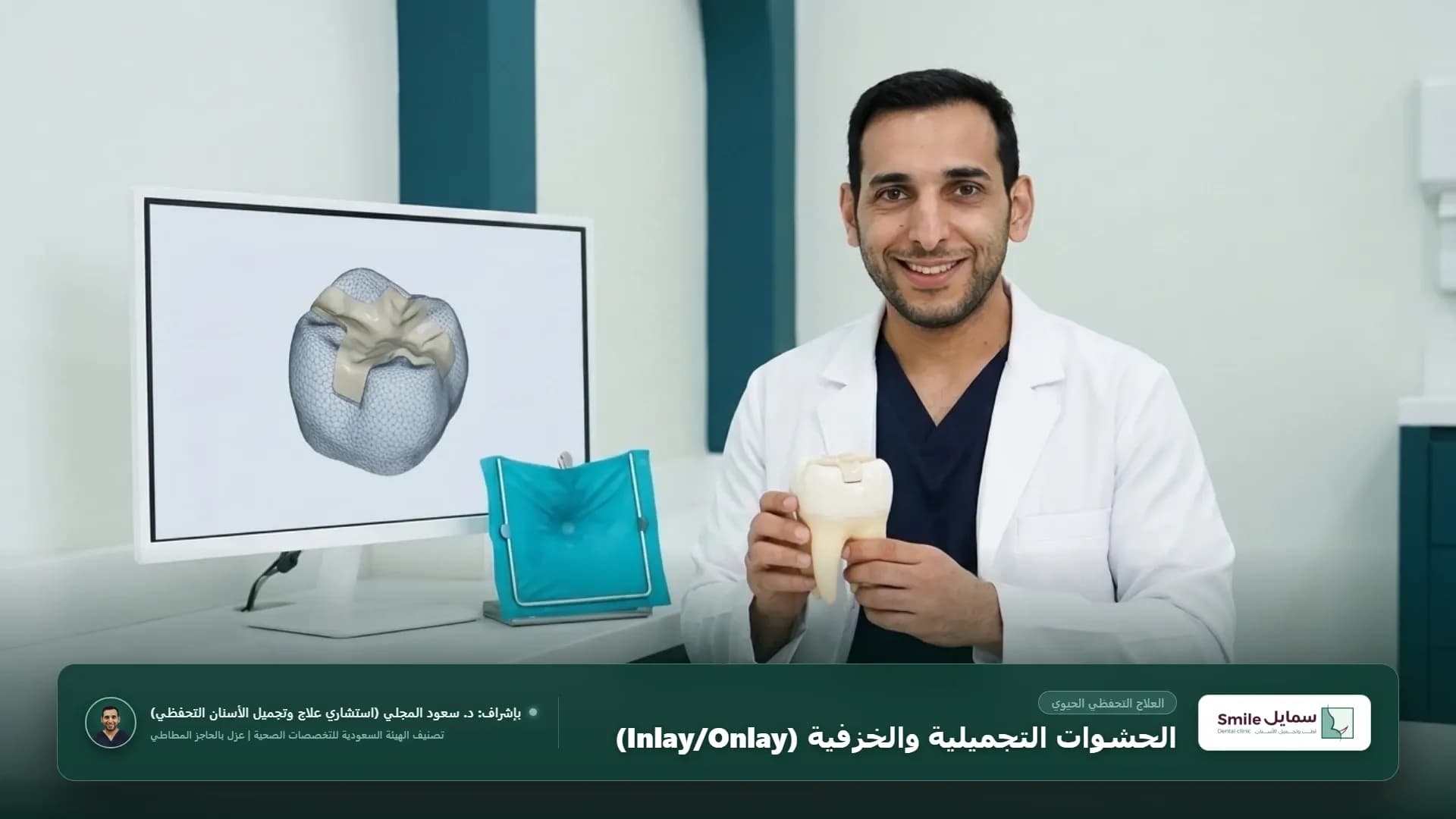
Quick, clinically verified answer: Ceramic inlays and onlays made in a CAD/CAM digital lab represent the peak of biomimetic dentistry: they protect a damaged molar from fracture with the strength of IPS e.max ceramic and preserve 50% to 70% of the healthy enamel structure compared with a full crown, provided they are placed under full rubber dam isolation with Immediate Dentin Sealing (IDS).
The Philosophy of Biomimetic Dentistry: Why We Protect Every Millimeter of Your Natural Tooth
In past decades, a patient with extensive decay in a molar had only two options: either a large traditional filling prone to shrinkage and fracture within two years, or preparing the tooth 360 degrees for a full crown, losing more than 65% of its healthy tissue. At the cosmetic fillings and dental restoration department in Riyadh at Smile Clinics, Dr. Saud Al-Mujalli follows a biomimetic protocol that mimics the natural structure of the tooth without excessive preparation.
This philosophy rests on a decisive biomechanical rule: the more of the natural, healthy enamel collar at the neck of the tooth (the bio-rim) we preserve, the longer the tooth lives and the lower the chance of the nerve becoming inflamed or needing a root canal later. Nano composite fillings and ceramic inlays/onlays therefore become a smart engineering bridge between a simple filling and a full crown.
1. Immediate Dentin Sealing (IDS) and Mandatory Rubber Dam Isolation
Many cosmetic fillings fail, and painful sensitivity on biting appears, because the dentin is contaminated by saliva or breath moisture during bonding. To ensure a chemical bond that lasts more than 10 to 15 years, Smile Clinics hold to two non-negotiable standards: 100% isolation of the tooth with a rubber dam throughout cleaning and bonding, and an Immediate Dentin Sealing layer to seal the dentinal tubules and prevent any sensitivity after the session. For more detailed clinical information, see our complete guide to cosmetic composite fillings and closing gaps between teeth without preparation.
2. When Do We Choose a Direct Nano Filling, and When Do We Move to a Ceramic Onlay?
When decay is small or moderate (less than a third to half the width of the chewing surface), nano-hybrid composite light-cured fillings placed in graded layers less than 2.0 mm thick achieve excellent aesthetic and functional results in a single session. But when the cavity is wider than half the distance between the cusps, or when replacing an old silver amalgam filling that has caused fine crack lines, a ceramic onlay surrounds the weakened cusps and protects them from sudden splitting. For more detailed clinical information, see our complete guide to retreating failed root canals with the ZEISS surgical microscope.
Clinical Comparison: Direct Nano Filling, Ceramic Inlay/Onlay, and Full Crown
The following table compares the three options for restoring molars to show when each is the most medically appropriate. For more detailed clinical information, see our complete guide to protecting the tooth after microscopic root canal treatment.
| Clinical criterion | Direct nano light-cured filling | Ceramic inlay / onlay | Full crown (360°) |
|---|---|---|---|
| Preservation of healthy tooth structure | Very high (only decay removed) | High (preserves 50% – 70% of the tooth) | Low (requires preparation all the way around) |
| Resistance to polymerization shrinkage and wear | Good for small and medium cavities | Excellent (0% shrinkage in the mouth – e.max ceramic) | Outstanding (zirconia or e.max) |
| Accuracy of side contact points (prevents food trapping) | Depends on the skill with the sectional matrix | Ideal with CAD/CAM digital design | Ideal with digital design |
| Best indication | Early or moderate decay and front-tooth fillings | Extensive decay, cracked cusps, conservative alternative to a crown | A completely broken-down molar, or protecting a tooth after microscopic root canal treatment |
| Expected lifespan | 5 – 8 years | 12 – 18 years | 15 – 20 years |
Steps for Placing a Digital Ceramic Inlay/Onlay and How to Look After It
Restoring a molar with an IPS e.max ceramic inlay or onlay at Smile Clinics in Al Aqiq follows a precise, conservative digital pathway that takes just two short sessions 24 to 48 hours apart, fully preserving the healthy tooth walls and the vitality of the nerve inside.
3. Conservative Preparation, 3D Scanning and Adhesive Bonding
In the first session, after comfortable electronic anesthesia and full rubber dam isolation, Dr. Saud Al-Mujalli removes the decay or old metal filling with microscopic precision and applies Immediate Dentin Sealing (IDS) to protect the nerve and prevent sensitivity. A 3D digital scan is then taken with the iTero Element 5D to send the design straight to our in-house digital lab, and the tooth is protected with a gentle temporary filling. In the second session, the ceramic inlay/onlay is checked and bonded with adhesive resin cement under rubber dam isolation, with precise bite adjustment and a final polish that mimics the smoothness of natural enamel.
Safely Replacing Old Silver Amalgam Fillings
4. Why Do Old Metal Amalgam Fillings Cause Cracked Teeth (Cracked Tooth Syndrome)?
Unlike ceramic and nano fillings, which bond chemically to the tooth walls and support them, metal amalgam doesn't bond to the tooth; it is packed mechanically into a wide cavity, and it expands and contracts with hot and cold drinks at a different rate from natural enamel. Over 10 to 15 years this creates fine hairline cracks in the tooth walls that can extend to the nerve. At Smile Clinics we replace amalgam safely under rubber dam isolation with high-volume suction to prevent swallowing any metal particles, then restore the tooth with a ceramic onlay from our digital lab within 24 to 48 hours.
Estimated Cost of Cosmetic Fillings and Ceramic Inlays/Onlays in Riyadh
The cost varies with the number of damaged tooth surfaces and the type of restorative material, and eligible Tawuniya dental insurance policies (the sole medical insurance provider accepted at Smile Dental Clinic) cover therapeutic fillings according to the coverage class:
Important note about prices: The prices in the table below are estimates; for an exact, approved price for your case, please contact customer service.
| Type of filling or conservative restoration | Estimated cost (SAR) | Time to complete and clinical guarantee |
|---|---|---|
| High-quality nano cosmetic filling (one to two surfaces – with rubber dam) | SAR 350 – 650 | One session (30 – 45 minutes) |
| Multi-surface molar rebuild with biomimetic nano composite | SAR 650 – 950 | One session with anatomical sculpting of the cusps |
| Digital ceramic inlay/onlay (IPS e.max – CAD/CAM) | SAR 1,400 – 2,200 | Ready within 24 – 48 hours in the digital lab |
Frequently Asked Questions About Cosmetic Fillings and Ceramic Inlays/Onlays
5. Why do I sometimes feel mild sensitivity when biting after getting a light-cured filling at other clinics?
Sensitivity usually happens because the filling's bite point is slightly high, or because no rubber dam was used during bonding, letting moisture leak in. With proper isolation, Immediate Dentin Sealing and the graded layering technique, this problem disappears completely at Smile Clinics.
6. Can a ceramic onlay hold firmly without covering the whole tooth like a crown?
Yes. Thanks to the microscopic chemical bond between lithium disilicate ceramic (IPS e.max) and tooth enamel through adhesive resin cement, the ceramic and the tooth become a single, cohesive biomechanical unit that withstands chewing forces for many years, as also explained in our guide to digital dental restorations from our CAD/CAM digital lab.
Location and branch: You can visit Smile Dental & Cosmetic Clinics – Al Aqiq Branch, Riyadh on Prince Mohammed bin Saad bin Abdulaziz Street, Al Aqiq, Riyadh, serving the Al Aqiq, North Riyadh, Al Malqa and Hittin districts, near Prince Mohammed bin Saad bin Abdulaziz Street (Al Khair Road) and the King Abdullah Financial District (KAFD), or view directions and verified reviews on our Google Business Profile on Google Maps.
Clinically reviewed and approved by:
Dr. Saud Al-Mujalli – Consultant in Restorative and Cosmetic Dentistry at Smile Clinics in Riyadh, classified and certified by the Saudi Commission for Health Specialties (SCFHS).
Regulatory notice: This content is for medical awareness and education in accordance with Article 23 of the Private Health Institutions Law in the Kingdom of Saudi Arabia, and does not replace a clinical examination and direct diagnosis.

