
Painless Surgical Extraction of Impacted Wisdom Teeth in Riyadh: How 3D CBCT Imaging Protects the Nerve
November 16, 2026
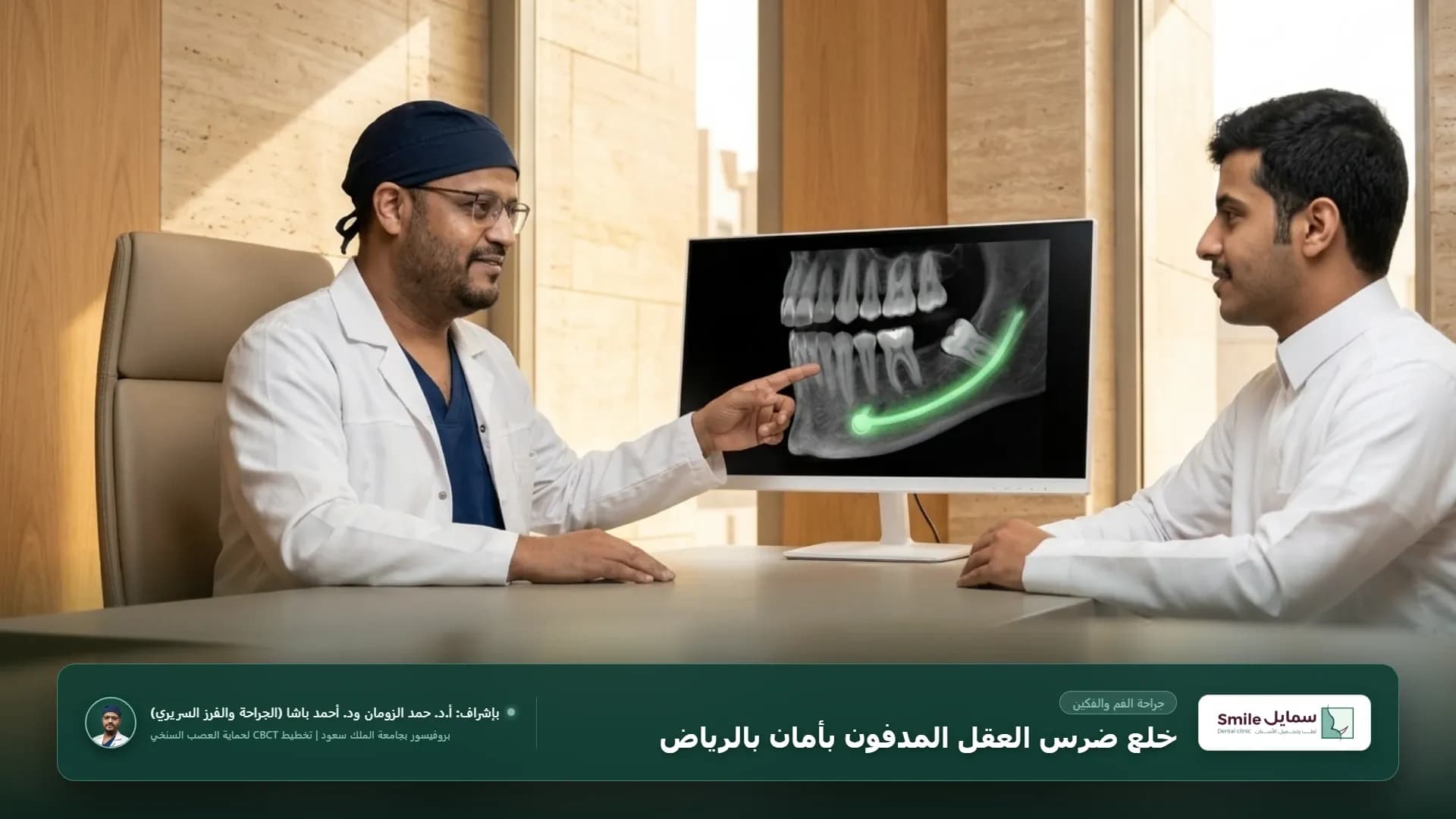
Quick, clinically verified answer: At Smile Clinics in Riyadh, impacted wisdom teeth are surgically removed without pain through advance planning with 3D CBCT imaging to measure the safe distance from the inferior alveolar nerve (2.0 mm or more), gentle minimally invasive sectioning of the tooth, and a safe dual pain-relief protocol in line with ADA guidelines, with clindamycin completely avoided.
When Does an Impacted Wisdom Tooth Become a Silent Threat to the Neighboring Teeth?
Wisdom teeth (third molars) usually come in between the ages of seventeen and twenty-five, and in about 70% of adults there isn't enough room in the jawbone for them to erupt straight, so they stay fully or partially impacted in the bone or gum at an angle or horizontally. At the oral and maxillofacial surgery and jaw joint department in Riyadh at Smile Clinics, Prof. Hamad Al-Zoman and Dr. Ahmed Basha stress that delaying assessment of a tilted impacted wisdom tooth can lead to hidden, deep decay on the back surface of the healthy second molar, turning a simple preventive procedure into the loss of two molars.
Wisdom tooth impaction is classified by the Pell & Gregory and Winter classifications as vertical, tilted forward (mesioangular – the most common, at 43%), fully horizontal, or tilted backward. Determining the angle of impaction precisely is the first step to a calm extraction that takes 20 to 40 minutes without excess bone trauma, especially when assessing cases of emergency treatment of severe molar pain caused by acute pericoronitis.
1. The Role of 3D CBCT Imaging in Keeping the Inferior Alveolar Nerve Safe
Patients' biggest worry before a lower wisdom tooth extraction is temporary numbness of the lip or chin caused by the roots being close to the inferior alveolar nerve (IAN) canal. Unlike flat panoramic X-rays, which can give the false impression that a root overlaps the nerve, Carestream CS 8200 3D CBCT imaging reveals the true position of the nerve canal to a fraction of a millimeter (cheek side, tongue side or between the roots), allowing the surgeon to gently section the crown and roots and lift them out well away from the nerve's path. For more detailed clinical information, see our complete guide to rebuilding worn upper jawbone with PRF membranes.
2. When Is a Conservative Coronectomy a Smarter Choice Than Full Extraction?
In rare cases where CBCT shows the root of a wisdom tooth with a healthy nerve wrapped directly around the nerve canal with no separating bone, the consultant uses a surgical coronectomy protocol: removing the crown of the tooth that is causing inflammation and pressure, and leaving the inactive root tips safely under the bone to protect the nerve almost 100%. For more detailed clinical information, see our complete guide to treating TMJ pain and clicking in Riyadh.
Comparing Types of Wisdom Tooth Extraction and Recovery Times
The following table shows the clinical differences between simple extraction and surgical extraction for partial and full impaction:
| Wisdom tooth case | Radiographic and clinical description | Expected procedure time | Initial recovery period |
|---|---|---|---|
| Extraction of a fully erupted wisdom tooth | The tooth is straight and fully visible above the gum | 10 – 15 minutes | 2 – 3 days |
| Partial soft tissue impaction | Part of the crown is covered by an inflamed gum flap | 15 – 25 minutes | 3 – 5 days |
| Full tilted or horizontal bony impaction | The tooth is buried in the bone and needs precise sectioning | 25 – 45 minutes | 5 – 7 days (swelling peaks at 48 hours) |
Safe Anesthesia and Recovery Protocol According to ADA and AHA 2021 Guidelines
3. Painless Extraction and Platelet-Rich Fibrin (PRF) Membranes
We start with deep local anesthesia using electronic anesthesia, and relaxing laughing gas can be added for patients anxious about surgery. After the tooth is gently removed and the socket cleaned with sterile saline, a platelet-rich fibrin (PRF) membrane full of growth factors, prepared from a small blood sample from the patient, can be placed to speed up gum and bone healing and greatly reduce the risk of dry socket.
4. Multimodal Pain Relief and Responsible Antibiotic Use
- First-line pain relief recommended by the American Dental Association (ADA): A carefully planned alternating combination of ibuprofen (400–600 mg) and paracetamol (500–1000 mg) for those without medical contraindications, which has proven superior to opioid painkillers with greater safety.
- Careful antibiotic stewardship: Extraction without systemic infection does not need a routine antibiotic. When there is a medical indication for endocarditis prophylaxis or a spreading infection, amoxicillin (2.0 g) or azithromycin (500 mg) is used, with a strict 100% avoidance of clindamycin in line with American Heart Association guidelines (AHA 2021).
Estimated Cost of Surgical Extraction of Impacted Wisdom Teeth in Riyadh
The cost varies with the degree of bony impaction, the number of teeth extracted, and Tawuniya dental insurance coverage (the sole medical insurance provider accepted at Smile Dental Clinic) for surgical extractions according to policy terms:
Important note about prices: The prices in the table below are estimates; for an exact, approved price for your case, please contact customer service.
| Wisdom tooth extraction procedure | Estimated cost (SAR) | Clinical safety inclusions |
|---|---|---|
| Simple extraction of an erupted wisdom tooth | SAR 400 – 750 | Local anesthesia + written recovery instructions |
| Extraction of a partially impacted wisdom tooth (soft tissue or mild bony impaction) | SAR 900 – 1,500 | Precise minimally invasive sectioning + fine cosmetic sutures |
| Surgical extraction of a fully horizontal impacted wisdom tooth near the nerve | SAR 1,500 – 2,600 | Advance planning with 3D CBCT imaging + suture removal follow-up |
Recovery Timeline and Instructions for the First 72 Hours After Surgical Wisdom Tooth Extraction
Following post-operative instructions plays a role as important as the surgeon's precision in achieving a calm recovery free of complications such as dry socket. Drawing on the experience of the surgical team at Smile Clinics in Al Aqiq, here is a precise timeline for the first week after removing an impacted wisdom tooth:
- The first 24 hours (stabilizing the protective blood clot): Apply gentle, continuous pressure on the sterile gauze for 45 to 60 minutes, and apply cold compresses to the outside of the cheek (15 minutes on, 15 minutes off) during the first 8 hours to reduce swelling by more than 50%. Completely avoid forceful spitting, rinsing, drinking through a straw, hot drinks and smoking.
- Days two and three (natural peak of physiological swelling): Mild swelling of the cheek naturally peaks after 48 hours and then gradually subsides. From day two you can start very gentle rinsing with lukewarm water and half a teaspoon of salt after meals without vigorous swishing, and continue with soft, cool or lukewarm foods (yogurt, warm soup, mashed potatoes).
- Days four to seven (rapid healing and suture removal): Most of the jaw muscle tightness gradually eases and you can return to normal eating on the opposite side. The fine cosmetic sutures are removed painlessly in a quick visit of no more than 5 minutes after 7 to 10 days, while checking that the gum has healed cleanly.
Frequently Asked Questions About Impacted Wisdom Tooth Extraction
5. Can two wisdom teeth (upper and lower on the same side) be removed in one session?
Yes. In fact, many patients prefer to have both teeth on the same side (for example, upper and lower right) removed in one visit, so they go through only one recovery period and can comfortably use the other side for soft chewing.
6. When can I return to work and exercise after surgical wisdom tooth extraction?
You can usually return to office work within 24 to 48 hours, while strenuous exercise and weightlifting should be postponed for 5 to 7 days to prevent a local rise in blood pressure and bleeding from the socket.
Location and branch: You can visit Smile Dental & Cosmetic Clinics – Al Aqiq Branch, Riyadh on Prince Mohammed bin Saad bin Abdulaziz Street, Al Aqiq, Riyadh, serving the Al Aqiq, North Riyadh, Al Malqa and Hittin districts, near Prince Mohammed bin Saad bin Abdulaziz Street (Al Khair Road) and the King Abdullah Financial District (KAFD), or view directions and verified reviews on our Google Business Profile on Google Maps.
Clinically reviewed and approved by:
Prof. Hamad Al-Zoman (Professor and Consultant in Periodontics and Dental Implants at King Saud University) and Dr. Ahmed Basha (General Dentist and head of emergency triage at Smile Clinics in Riyadh), both certified by the Saudi Commission for Health Specialties (SCFHS).
Regulatory notice: This content is for medical awareness and education in accordance with Article 23 of the Private Health Institutions Law in the Kingdom of Saudi Arabia, and does not replace a clinical examination and direct radiographic diagnosis.


